Sweeps and blocks: reading options execution urgency
A sweep is an aggressive options order split simultaneously across multiple electronic exchanges to fill immediately at the best available prices, while a block is a large, negotiated trade executed on a single venue.
Size can hit the options tape quietly or loudly. Two orders with identical contract counts and total premium can leave entirely different footprints on the exchange tape: one prioritizing maximum speed across fragmented liquidity venues, and the other prioritizing controlled execution price without broadcasting intent.
Understanding how sweeps and blocks are routed and reported helps traders evaluate order flow context without drawing unsupported conclusions about trader intent or future stock movement.
Inspect a live unusual options report
See how sweeps, blocks, and cumulative net premium look on actual covered ticker data. Zero signup required for your first scan.
What is an intermarket sweep order (SWEEP)?
US options liquidity is fragmented across multiple electronic venues. Each venue displays its own order book with limited contract volume at the National Best Bid and Offer (NBBO).
When a market participant wants to execute a large order immediately—larger than the liquidity displayed at any single exchange—they use an Intermarket Sweep Order (ISO):
- Simultaneous Routing: Smart order routers split the parent order into multiple child orders and route them simultaneously to every exchange displaying top-of-book quotes at the NBBO.
- Speed over Price Improvement: Sweeps sweep across venues in milliseconds, taking whatever contracts are available at the ask (for buys) or bid (for sells). If liquidity at the top level is exhausted, the router sweeps the next price tier.
- Tape Footprint: On the options tape, a sweep surfaces as a rapid cluster of prints in the same contract, with identical or near-identical timestamps, marked with the provider's
SWEEPexecution flag.
What is a block trade (BLOCK)?
A block trade is a large, single-venue options transaction—typically representing 50 or more contracts or significant dollar premium—that is negotiated privately off-screen between institutions or crossed through an executing broker.
Unlike sweeps, blocks do not race across electronic exchange order books:
- Single-Venue Crossing: The entire contract size is brought to a single exchange floor or electronic crossing mechanism and executed as one single print.
- Patience over Urgency: Block trades are often negotiated when institutional market participants want to avoid market impact (moving the quote against themselves).
- Mid-Market Execution: Because blocks are crossed as negotiated trades, they frequently execute between the prevailing bid and ask prices (mid-market), or are accompanied by offsetting equity trades (delta-neutral stock crosses).
Provider-labelled multi-venue execution associated with urgency and fragmented liquidity.
Outsized single print negotiated off-screen or crossed on one exchange. Prioritizes controlled impact over rapid execution speed.
Ask-side vs. bid-side execution context
Every print on the options flow tape is evaluated relative to the National Best Bid and Offer (NBBO) at the moment of execution:
- At Ask / Above Ask: The transaction filled at or above the prevailing offer quote. Tape convention classifies this as buyer-initiated, indicating an incoming order aggressive enough to lift the ask price.
- At Bid / Below Bid: The transaction filled at or below the prevailing bid quote. Tape convention classifies this as seller-initiated, indicating an incoming order aggressive enough to hit the bid price.
- Mid-Market: Fills occurring between the bid and ask quotes—common for block crosses—stay genuinely ambiguous regarding aggressor side.
Why trade side tags require healthy skepticism
Quote-side tags provide useful context, but they are proxies rather than facts:
- Flickering Quotes: In volatile markets, quotes move in microseconds. A fill tagged "at ask" might be a stale quote update rather than an aggressive buyer.
- Multi-Leg Strategies: A trader executing a vertical spread or iron condor may buy one leg at the ask and sell another leg at the bid. Inspecting one leg in isolation misreads the overall position.
- Market Maker Facilitation: For every aggressive buyer lifting an ask, a market maker is passively selling at that ask and hedging their risk.
Repeat prints, split orders, and Surge Detection
Institutional traders often try to disguise large positions by splitting a massive order into smaller clips executed over several minutes or hours.
On the tape, this surfaces as repeat prints: identical contract specifications (same strike, same expiration) hitting the tape in rapid succession.
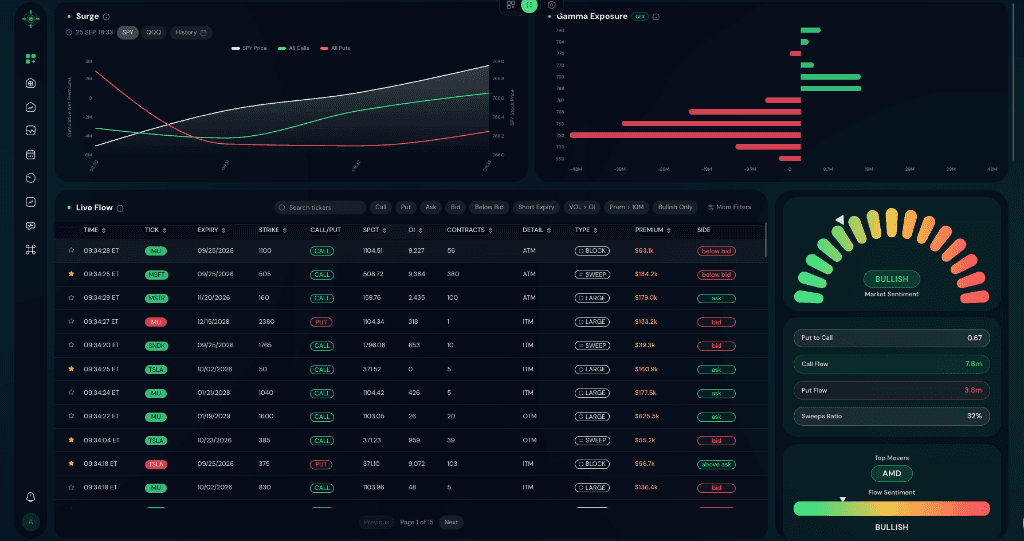
[Illustrative product surface] This capture shows an Options Sight flow workspace. Confirm the current runtime entitlement and chart labels before describing a dedicated Surge Detection module as live evidence.
When repeat sweeps or blocks cluster on a single ticker within a short window, the flow surface can help you inspect whether activity is concentrating relative to the ticker's baseline. The classification is descriptive, not a forecast.
See verified Live Flow capabilitiesBoundaries of observation: what sweeps and blocks cannot establish
A practical 5-step framework to evaluate execution urgency
Check the underlying equity
Review company announcements, earnings dates, and current price trends.
Inspect contract specifics
Note the strike price, expiration date, premium, contract count, and distance from spot price.
Analyze execution mechanics
Confirm whether the print was an intermarket sweep or block, and whether it executed at the ask or bid.
Compare volume to open interest
Evaluate whether Vol > OI, and observe whether open interest updates following overnight clearing.
Observe the boundary of the tape
Recognize that a single recorded print never establishes the participant's complete portfolio, intent, or hedge structure. Contextualize the print within broader independent market research.
Frequently asked questions
What is the difference between a sweep and a block trade?
A sweep order is broken into smaller lots and sent to multiple electronic exchanges simultaneously to grab all available liquidity at the best prices immediately. A block trade is a single large transaction negotiated off-screen and crossed on one exchange venue.
Is a call sweep always bullish?
No. While a call sweep at the ask indicates aggressive demand for call options, it can be a hedge against a short stock position, one leg of a spread, or a short-term scalp trade.
Why do block trades often execute mid-market?
Block trades are often negotiated between institutional counterparties or crossed by floor brokers. Crossing mid-market provides price improvement for both sides compared to hitting the outer bid or ask quotes.
How does Options Sight classify sweeps and blocks?
Options Sight receives normalized options market feeds from Intrinio, preserving provider-classified sweep, block, and large trade tags and displaying them transparently across Live Flow and Scanner surfaces.
Authoritative references and disclosures
Open Interest: Why It Matters
Daily Volume and Open Interest Reports
Options Trading Basics and Risks
Regulatory Disclosure: Options Sight is a market-intelligence and options research organization platform, not an investment adviser, broker-dealer, or financial analyst. Options trading involves substantial risk of loss and is not suitable for all investors. This educational guide describes recorded exchange data and does not provide investment or financial advice.